ARCHITECTURE.md - Linumed Base
Overview
Linumed Base is not a custom operating system and not a bootable image. It is an Infrastructure-as-Code kit built on Ansible that turns a standard Debian 13 (Trixie) installation into a hardened, GDPR-aware healthcare infrastructure platform.
"GDPR-aware", deliberately not "GDPR-compliant". Compliance is a property of a processing activity, not of a software package - it depends on the legal basis, the processing register, the data processing agreements, the retention periods, the application running on top and who is given access, none of which this kit knows or controls. What it does contribute is concrete and testable: host hardening, TLS on every exposed path, encrypted backups with a restore test that actually runs, every management interface bound to loopback, and no telemetry leaving the host. That makes a compliant deployment possible; it does not make one.
The target audience is IT departments and system administrators at clinics and care facilities who want to run open-source software but don't have the time or expertise to build a healthcare-compliant stack from scratch.
Design principles
On-premise by design Linumed Base is built to run in the institution's own infrastructure. There is no cloud dependency, no telemetry call-home, no SaaS component. All data stays in-house.
GDPR as a constraint, not a feature Data protection requirements are built into every design decision: local data storage, encrypted backups, a minimal logging surface, no transfer of personal data to third parties.
Idempotency All Ansible playbooks are idempotent. A second run produces no changes. That is a hard requirement, not a recommendation.
FOSS-only in the core Every component of Linumed Base is free open-source software. Linumed Shifts (the commercial product) is not part of this repository and is licensed separately.
EU infrastructure No dependencies on US-only services. Pulling images from Docker Hub is accepted, but images run on EU infrastructure. EU-based alternatives are preferred for CI/CD.
Target architecture (v0.1)
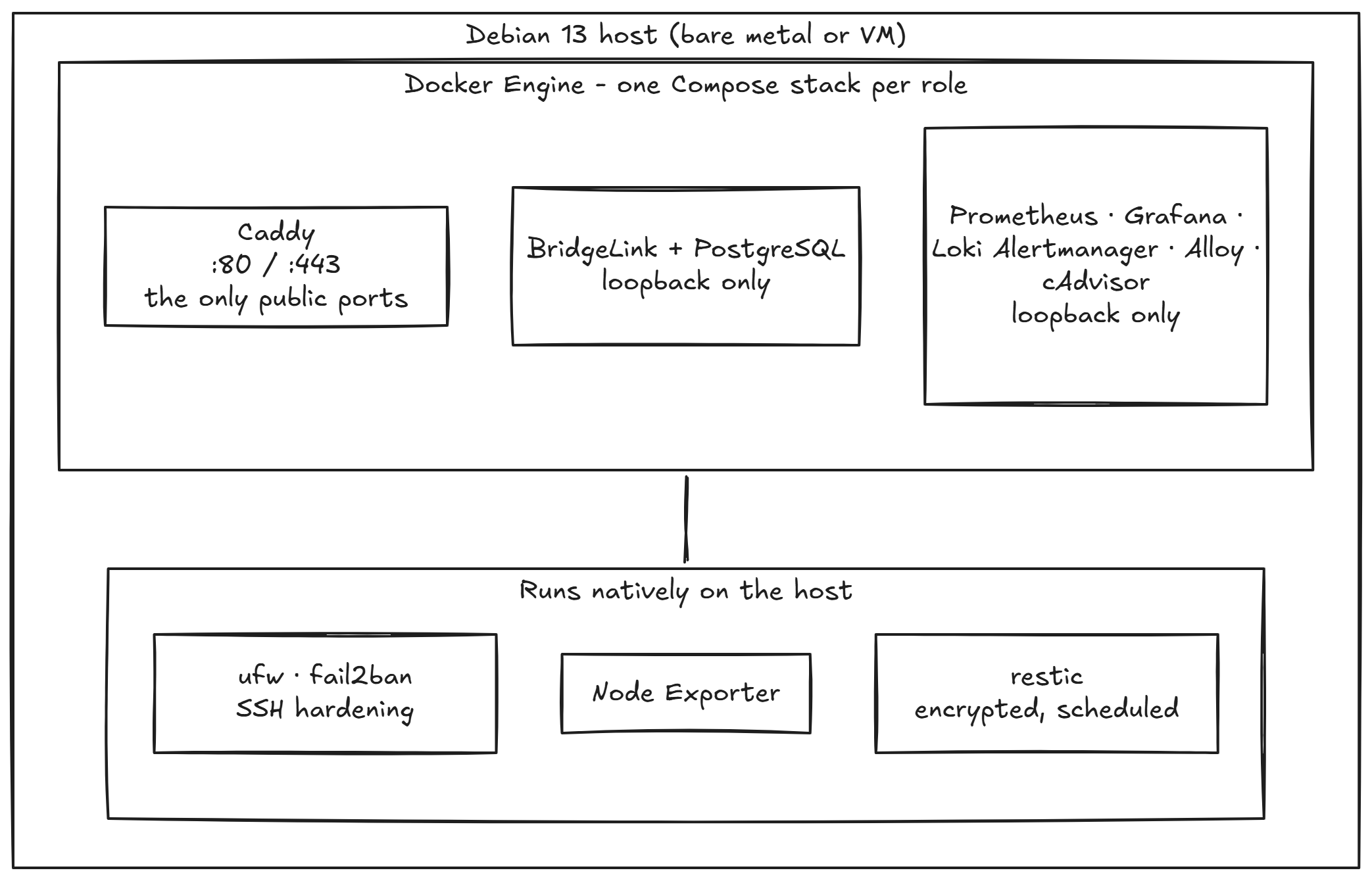
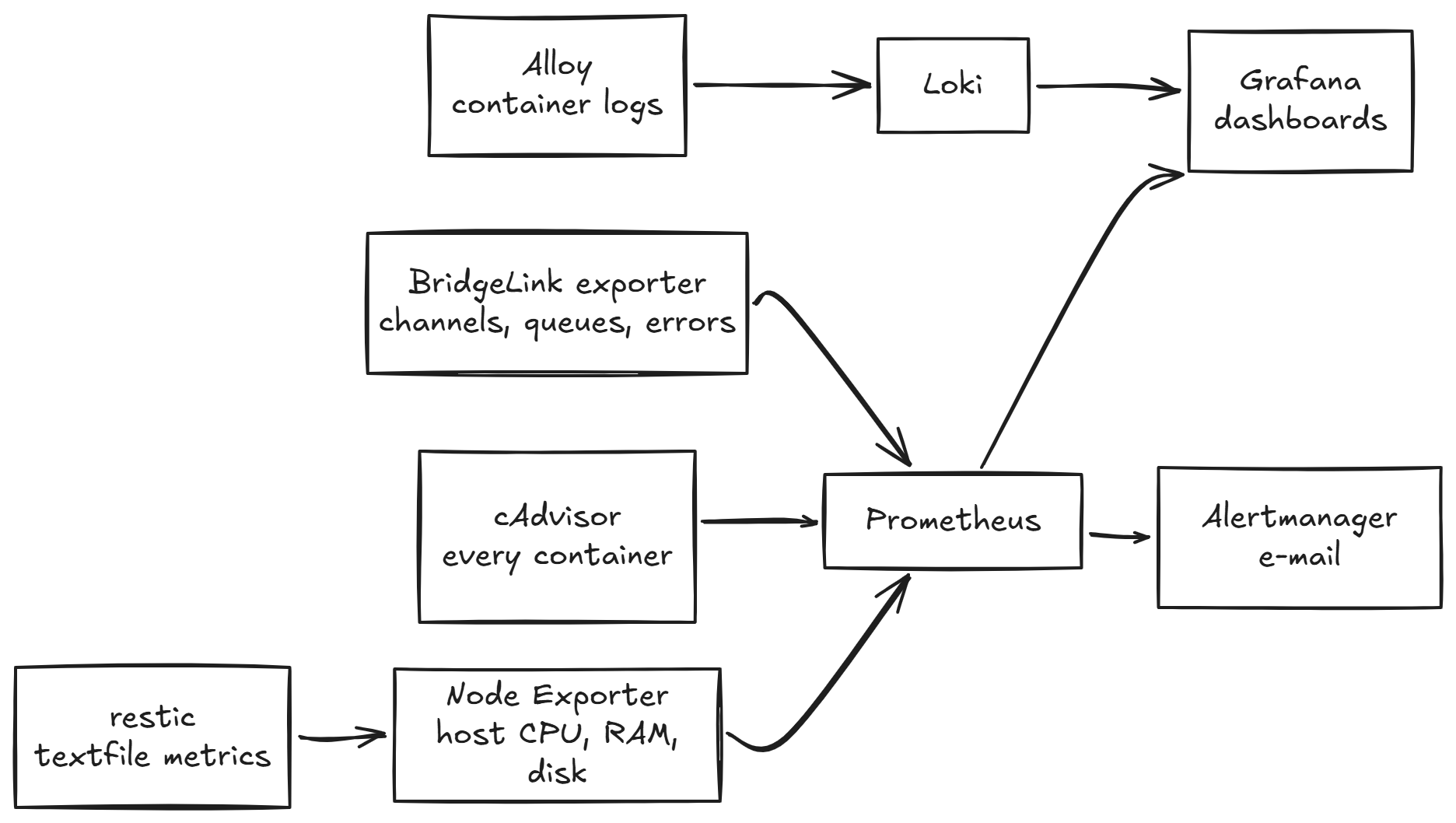
Deliberately two figures rather than one. This one answers what runs where and carries no arrows at all; the flows are the next one. The previous single diagram mixed containment with three different kinds of arrow - a security property, a data flow and a backup operation - and drew two of them at the Docker group's boundary, which is the one thing the renderer reliably gets wrong (issue #65).
Components
common (Ansible role)
Base hardening of the Debian system. Always runs first.
Covers: - SSH hardening (PasswordAuthentication off, configurable port, AllowUsers) - ufw firewall (default deny incoming, only explicitly allowed ports) - fail2ban (SSH brute-force protection) - unattended-upgrades (automatic security updates) - timezone and NTP configuration - basic system packages
caddy (Ansible role)
Caddy as a reverse proxy with automatic TLS via ACME (Let's Encrypt or a private CA), run as a Docker Compose stack.
Configuration via a Caddyfile, generated from Ansible templates.
Design decision - Caddy as a container, not native on the host:
the original plan was to run Caddy natively so TLS termination would
survive a Docker restart. Checked (as of 2026-08-10): Debian 13 ships
caddy at version 2.6.2 with 11 open security issues in the Debian
security tracker, while the container runs current upstream 2.11.x.
For the most exposed component in the whole stack, "native" would
therefore not be safer but measurably less safe - the patch-cadence
advantage that would otherwise justify running native works against it
here. The original availability argument barely holds either: if every
backend is itself a container, a surviving Caddy with no reachable
upstream just returns 502 instead of connection refused - no
practical gain. A real kill switch (e.g. during a security incident)
belongs in its own documented network-level procedure (ufw deny,
interface down) in the operations runbook, not as a side effect of
where the proxy runs.
Docker publishes container ports past ufw (see the security model
below) - for Caddy that's intentional on 80/443, since the proxy has to
be reachable from outside. Any further ports: entry in this Compose
stack has to account for that trap deliberately.
bridgelink (Ansible role)
HL7 v2 integration engine, run as a Docker Compose stack. The engine used is BridgeLink.
This is not a replacement for Mirth Connect, but the same codebase
under a different name: same channel XML, same administrator, same
transformers and connectors - the Java packages are still called
com.mirth.connect. NextGen Healthcare moved Mirth Connect to a purely
commercial, proprietary license in March 2025 (source closed from 4.6
onward); the open-source line has continued under new names since, and
Linumed Base follows that open line. Mirth Connect remains the industry's
de-facto standard - channels are portable between all variants, so an
institution keeps its integration work if it ever wants to switch.
Full reasoning, including evaluated alternatives (Open Integration Engine, licensed Mirth 4.6+, frozen 4.5.2), accepted downsides and revision triggers: ADR 0001.
Protocols supported out of the box, measured against the pinned image's own extension list: HL7 v2.x, HL7 v3, DICOM, EDI/X12, NCPDP, delimited text (CSV), XML, JSON, raw - with MLLP, TCP, HTTP, file, JMS, SMTP and JDBC connectors.
FHIR is not among them. The engine ships no FHIR data type and no
FHIR connector: FHIR was never part of Mirth Connect's open-source core,
only of NextGen's commercial extensions, so the open fork does not
inherit it. A FHIR endpoint can be built here - an HTTP listener with
the JSON data type - but that gives transport and parsing, not a
resource model, validation, search semantics or a CapabilityStatement.
The FOSS route to those would be the HAPI FHIR libraries loaded into
the engine; how a library reaches the classpath in this image is not
established, and the directory names in it are misleading - see
docs/roles/bridgelink.md and issue #98. Anyone whose requirement
is a FHIR server wants a real one next to this kit, which by this
repo's own boundary is application software (ADR 0011).
Docker Compose stack: - BridgeLink (hardened image: Debian 13, no shell, non-root) - PostgreSQL (configuration and message database)
Only the admin/API port is published, and only on 127.0.0.1. Channel
ports (HL7 MLLP or similar) are deliberately not published by the role
- that's a per-site decision.
monitoring (Ansible role)
Observability stack. Most components run as a Docker Compose stack; Node Exporter runs natively.
Components:
- Prometheus - metrics scraping and storage (container)
- Grafana - dashboards, three vendored default dashboards included
(host overview, container overview, log explorer) - deliberately
generic infrastructure dashboards, not clinical or patient-related:
the monitoring stack sees metrics and logs, not the integration
engine's message contents; bound to 127.0.0.1 only by default,
access via SSH tunnel (container)
- Loki - log aggregation (container)
- Grafana Alloy - ships host and container logs to Loki
(container). Replaces Promtail, which reached end-of-life on
2026-03-02 and gets no more security fixes - not an option for a
GDPR-focused kit.
- Alertmanager - alert routing (container)
- Node Exporter - host metrics (CPU, RAM, disk, network). Native
Debian package instead of a container: gets security updates
automatically through the existing unattended-upgrades role, needs
no --pid=host/rootfs mounts, and ufw can actually protect the port
- with a published container port that protection would be
ineffective (see the security model below).
- cAdvisor - container metrics (container)
cAdvisor covers every container generically, which is why the gap it
leaves is easy to miss: for BridgeLink it reports CPU, RAM and network
of the process, and nothing about whether messages are actually moving.
A stopped channel or a queue that stops draining looks identical to an
idle, healthy engine from the outside. BridgeLink exposes no /metrics
of its own, so the bridgelink role ships an opt-in exporter sidecar
that translates its REST API into channel-level metrics.
Prometheus reaches that sidecar by container name over a shared Docker
network (linumed-base-metrics), not over a host port - the two stacks
are separate Compose projects, and neither a loopback-published port
(unreachable from another container) nor an all-interfaces one
(bypasses ufw) is an option. The Node Exporter job's
host.docker.internal works only because Node Exporter is a native
service, not a container. Both switches
(bridgelink_exporter_enabled, monitoring_scrape_bridgelink) are off
by default - see docs/roles/bridgelink.md.
Retention is split by data kind, not a single global value: metrics
(monitoring_metrics_retention_days, default 90) and logs
(monitoring_logs_retention_days, default 30, shorter) - logs can
contain personal data (IP addresses, usernames), so the shorter
retention here is data minimization, not an arbitrary choice.
backup (Ansible role)
Encrypted backups with restic. Supported backends: - local (another directory / external drive) - SFTP (e.g. another server on the network) - S3-compatible (optional, e.g. Hetzner Object Storage)
Backup schedule via a systemd timer (not cron). Monitoring integration: restic results are pushed to Prometheus as metrics.
Network design
Decided, not open: no Linumed Base management interface is reachable
from outside. Every component binds to 127.0.0.1 or publishes no
host port at all; access goes through an SSH tunnel. Each Compose stack
has its own Docker network by default.
Two shared networks exist, and neither weakens that: linumed-base-external
lets the operator's own stacks be reached by Caddy (issue #39), and
linumed-base-metrics lets Prometheus scrape an exporter that lives in
another stack (issue #64). Both are internal Docker networks with no
host port and no route from outside; they exist so that container A can
reach container B without publishing anything, which is the opposite
of an exposure. This is explicitly not a return of the linumed-net
idea below - that one was about routing this kit's own management UIs
through a reverse proxy, which remains dropped.
A shared network (linumed-net) through which Caddy would route the
kit's own services was originally planned as the target picture and has
been deliberately dropped - along with the SSO integration that
would have been built on top of it. Reasoning, evaluated alternatives
(reverse proxy with an identity provider, mesh VPN) and the accepted
downsides:
ADR 0003.
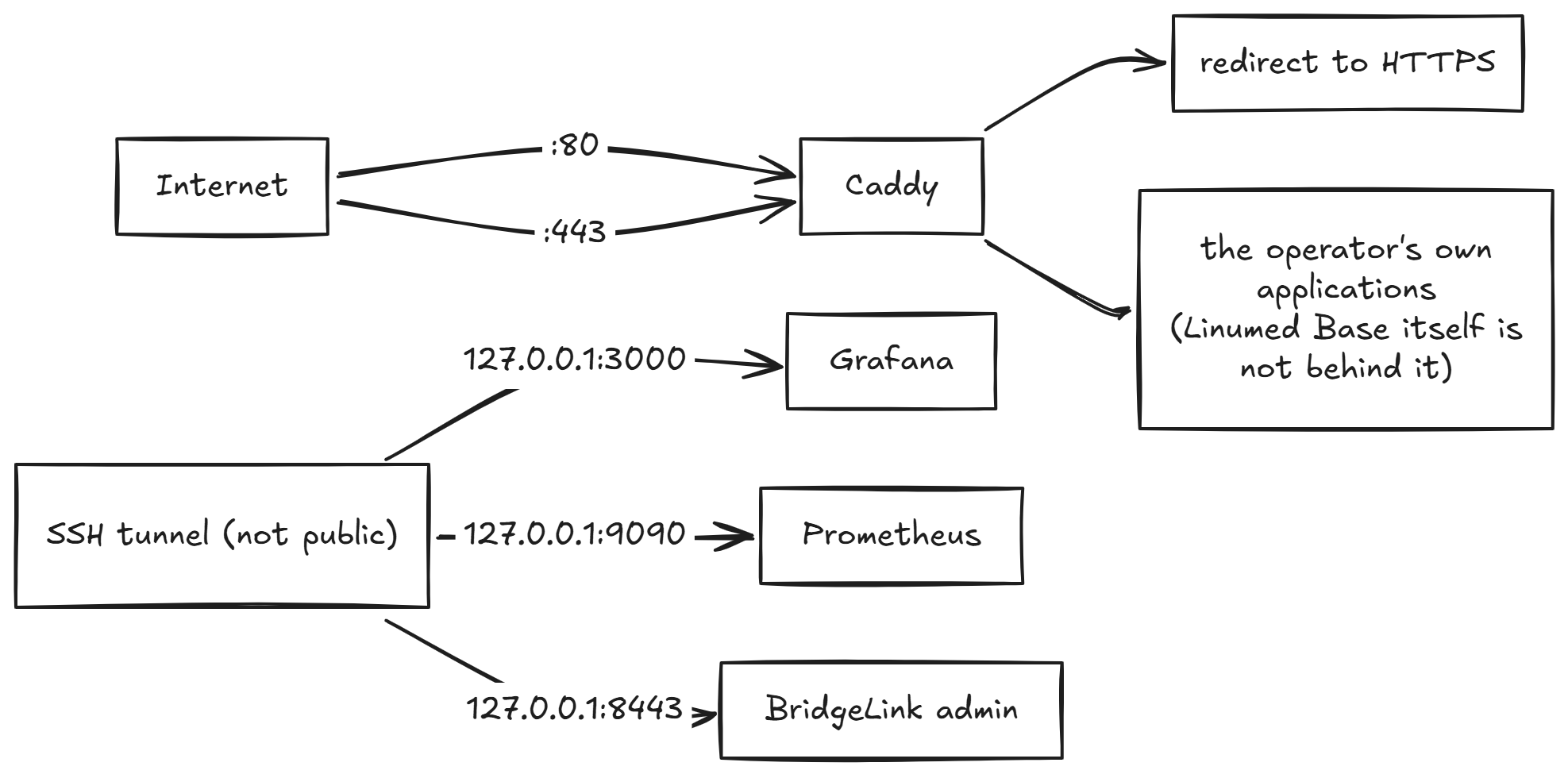
Caddy is the reverse proxy for the institution's own applications,
not for this kit's management interfaces. It joins a second Docker
network (linumed-base-external, created unconditionally by the caddy
role) for exactly that purpose, independent of the access decision
above: an operator's separate Compose stack joins the same network as
external: true and is then reachable by service name, without
publishing a port or touching ufw. See docs/roles/caddy.md.
Because everything stays bound to loopback, Linumed Base works over whatever network the operator already runs - a corporate VPN, a mesh, a jump host, or the clinic LAN - without needing to know about any of it. That composability is the reason for the decision, not a side effect of it.
Storage strategy
All persistent data lives in named Docker volumes, no bind mounts to host paths except explicitly documented exceptions.
| Service | Volume | Contents |
|---|---|---|
| bridgelink | bridgelink_appdata | keystore, server.id, runtime data |
| postgresql (BridgeLink) | bridgelink_db_data | channel configuration and messages |
| prometheus | prometheus-data | metrics (retention: 90 days default) |
| grafana | grafana-data | dashboards, user settings |
| loki | loki-data | log data (retention: 30 days default, shorter than metrics - see the monitoring role) |
Node Exporter has no volume of its own - it runs natively, and host metrics aren't persisted there (Prometheus takes care of that).
restic backs up /var/lib/docker/volumes/ via direct file access, plus
/opt/linumed-base/ (role configuration, secrets). Backups run daily via
a systemd timer. The result isn't pushed to Prometheus; it's written as
a Prometheus textfile metric (the same mechanism the native Node
Exporter uses) - Prometheus picks it up on its regular scrape, no
pushgateway needed.
Recovery tests are mandated as a documented process (a GDPR
requirement). The backup role runs one automatically, weekly, on its
own systemd timer independent of the daily backup - restore into a
throwaway target, diff against the live source, write the result as
its own textfile metrics so a restore test that silently stops running
is exactly as visible as one that starts failing. See
docs/roles/backup.md.
Inventory structure
ansible/inventory/
└── example/
    ├── hosts.yml            # Example inventory (no real hosts)
    └── group_vars/
        ├── all.yml          # Global variables (timezone, NTP, etc.)
        └── linumed/
            ├── vars.yml            # Linumed-specific, non-secret defaults
            └── vault.yml.example   # Template for the required secrets (Ansible Vault)
For a real deployment, the administrator creates their own inventory outside the repository and references the roles.
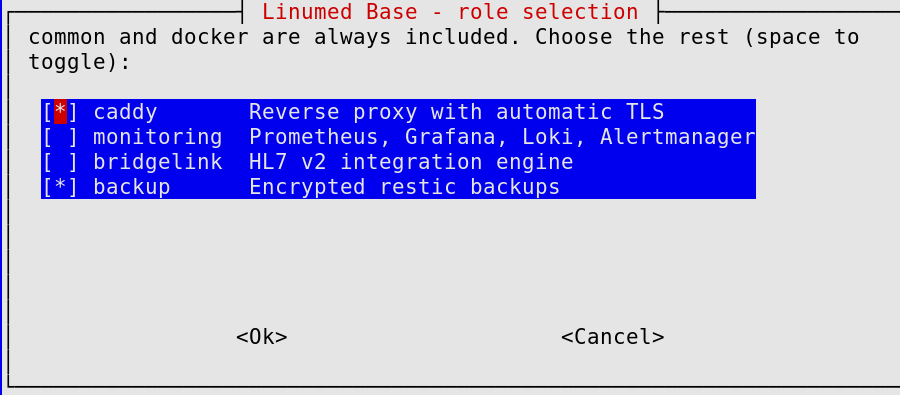
Optional roles (everything but common and docker, which are always applied) are
picked via scripts/select-roles.sh, a whiptail checklist that writes
linumed_base_roles into vars.yml - see README.md's Quick start section and
scripts/README.md for usage:
Security model
- every connection TLS-encrypted (Caddy + ACME)
- SSH key-only, no password login
- firewall default-deny, minimal opening
- Docker bypasses ufw: a container port published via
ports:is reachable despite active ufw rules (Docker's own iptables/nftables rules sit ahead of ufw's rules in the chain). Hence this kit's default: publish nothing that doesn't need to be publicly reachable (the exception is Caddy on 80/443, which is intentional) - everything else gets either no host port at all or an explicit127.0.0.1binding. - Docker containers run unprivileged, no
--privileged - secrets via Ansible Vault or an external
.envfile (never in the repo). Passwords a container needs at runtime go in as a Docker secret from a file, not as an environment variable - env vars are readable by anyone allowed to rundocker inspectand end up in the container config on disk. - From the bridgelink role onward, the stack processes real patient
data. Up to that point it only holds operational data (metrics,
logs); an integration engine, by contrast, moves HL7 messages
carrying names, dates of birth and diagnoses, and its database stores
them depending on channel settings. That shifts the requirements for
backup (the
backuprole), retention and access control from "securing infrastructure" to "processing health data" - seedocs/roles/bridgelink.md, the GDPR section. - backup data is encrypted (restic + password via Vault)
- automatic security updates for the host system (unattended-upgrades also covers natively installed packages like Node Exporter, not just container images)
Scope: Linumed Base vs. Linumed Shifts
| Linumed Base | Linumed Shifts | |
|---|---|---|
| Type | open-source IaC kit | commercial, on-premise application |
| License | MIT | proprietary |
| Content | infra stack, integration engine, monitoring | shift scheduling for care wards |
| Repo | Linumed/Base | Linumed/Shifts (private) |
| Audience | IT admins, system integrators | care management, ward leads, nursing staff |
| Dependency | independent | can run on top of Linumed Base |
Linumed Shifts is not in this repository and is not documented here.
Versioning strategy
- v0.1: common + docker + caddy + monitoring + bridgelink + backup
- v0.2: operational readiness - a working onboarding path, the
operations handbook, access hardening (shell-less tunnel users, real
Grafana users), an automated restore test. See
docs/ROADMAP.md. - v0.3: the product's own name (Linumed Base, ADR 0006), BridgeLink
application metrics, and the diagram/documentation work that came with
them. No new role. See
docs/ROADMAP.md. - v0.4: the DICOM stack (Orthanc), plus the maintenance the kit did not
do before - scanning the pinned images for known vulnerabilities,
answering the lifecycle questions (Debian major upgrade, teardown, the
single-host assumption), and a playbook for the runtime-agnostic
subset. See
docs/ROADMAP.md, Stage 6. Orthanc was earmarked as v0.3 until 2026-08-20; that number went to the rename and the observability work instead. This entry is what was planned, not what stands today: Orthanc shipped in v0.4 and was removed again five days later in v2.0.0 (ADR 0011) - see the release-by-release history below this list for what actually happened from v1.0 onward. - v1.0: the point from which breaking changes require a major version bump. What that promise covers is written down rather than left to interpretation - variable names, deploy paths, container and network names, this kit's own metric and alert names, dashboard and datasource UIDs, systemd unit names, and the set of variables with no default. See ADR 0008, which also lists what is deliberately not covered (pinned image versions have to keep moving) and what has to be cleaned up before the tag, because 1.0 freezes whatever exists at that moment. An earlier version of this line also named "certification prep"; that term appeared exactly once in the entire repository and was defined nowhere, so it was removed rather than left as an expectation nobody had committed to. If a specific certification ever becomes a goal, it gets named, scoped and given its own issue.
No bundled identity provider. The Authentik role originally planned for v0.2 has been dropped (ADR 0003): it would have required an outward-facing opening that this kit deliberately avoids. Instead of shipping an identity provider, Grafana gets an optional connection to an existing one (OIDC).
Application software (HIS, DMS, document management) is deliberately not part of Linumed Base. The clinic runs its own applications. Linumed Base provides the hardened foundation they run on - see the note on "GDPR-aware" under Overview for where that foundation stops.
Every release is tagged as a git tag, and versions follow Semantic
Versioning. For a 0.x project that means the opposite of what an earlier
version of this sentence claimed ("breaking changes only from v1.0
onward"): before 1.0 there is no stability guarantee at all. Breaking
changes can and do land in minor releases, and each one is called out
under ### Breaking in CHANGELOG.md - v0.2.0 moved the Caddyfile,
v0.3.0 renamed every identifier and moved Prometheus's configuration
into its own directory.
v1.0.0 was tagged 2026-08-22; v2.0.0 followed 2026-08-27, five days later, when
Orthanc turned out to be application software by this project's own definition and was
removed entirely (ADR 0011) - a breaking change against the ADR 0008 surface, so a major
bump, not a patch on top of a release five days old. From here a breaking change again
requires a major version bump. That promise was not a quality label to reach and did not
arrive by itself - it is a deliberate promise about future releases, made only once the
surface it covers had been measured and, where it should not have been frozen, narrowed
(ADR 0010).
v2.0.1 followed on 2026-09-04 and is what the other side of that promise looks like:
a documentation release that touches no role, variable or default, so nothing in the ADR
0008 surface moves. It exists because the quick start shipped in v2.0.0 could not be
followed at all.
v2.1.0 followed on 2026-09-11 - test/vm-test-quickstart.sh, a permanent release
test that runs the quick start verbatim against a real netinst install, plus two more
quick-start defects (#106) that its first run found. Again no role, variable or default
changed, so nothing in the ADR 0008 surface moves; the minor bump is for the new test
script, not for anything a deployed instance would notice.
v2.1.1 followed on 2026-09-16 - six documentation and CI-maintenance fixes, none of
them touching the ADR 0008 surface. Four pinned images had fallen behind (#108, caught by
the weekly image-scan job), which in turn surfaced a stale pin table
(docs/operations/updates.md) and a vm-test.sh throwaway VM disk too small for the
current image set. The other five (#109, #110, #111, and Website#31/#32) were reported
from outside by cc@prod against the published documentation site: a wording
contradiction, a stale version-plan bullet, a ROADMAP.md readability fix, a RAM-table
figure that looked wrong but wasn't, and a quick-start caveat easy to miss inside a code
block.
v2.2.0 followed on 2026-10-09 - the BridgeLink engine moves from the 26.6 to the 26.9
series, alongside Alloy 1.20 and Alertmanager 0.34 (#124). For the role nothing changed -
same image internals and API, measured - but the engine's own upstream changes can affect
operators' channels, which is why this is a minor and not a patch release. Nothing in the
ADR 0008 surface moves. It also makes CI failures reach someone (#117): the weekly
image-scan had been red for three weeks unnoticed (#115).
The scope of that promise is defined in
ADR 0008.
The surface was measured, not estimated: re-measured against all seven roles on
2026-08-21, then again against six roles on 2026-08-23 after Orthanc's removal
(#92/ADR 0011). Current: 120 interface role variables (plus four recorded as
internal in ansible/internal-variables.txt, see ADR 0010), 11 container
names, 13 alert rule names, four systemd units, seven variables a plain run
aborts without, and
the Grafana dashboard and datasource UIDs that every operator-built panel
references.